Mid-Levels, Central and Western, Hong Kong - October 8, 2026: Four companies will quote an Internet of Things Fire Detection System, and all four will be quoting something different - a box, a radio, a dashboard, or a service contract. On a 5-storey block on Caine Road - an estate block with a management office, a residents' committee and an existing maintenance contractor - the answer that matters is the one the Fire Services Department wrote down on 30 April 2026. FSD Circular Letter No. 3/2026 accepts an IoT Fire Detection System, paired with portable fire extinguishers, as an alternative to the hose reel system and the manual fire alarm system in composite and domestic target buildings of six storeys or below regulated under the Fire Safety (Buildings) Ordinance, Cap. 572. This is written for the buyer who has to commission the system rather than the buyer who has to admire it - layers, limits, tests, documents and costs, in that order. The authority for the programme is the Fire Services Department, https://www.hkfsd.gov.hk/, whose Building Improvement Support Centre on 2272 9112 handles the application route.
Key facts on the record
1. Circular Letter No. 3/2026, issued 30 April 2026, accepts an IoT Fire Detection System plus portable extinguishers in place of hose reel and manual fire alarm systems for target buildings of six storeys or below.
2. The pilot ran in ten buildings across ten districts, assessed 1 January to 31 March 2026, and recorded no false alarms, a 100 per cent online rate and better than 99.95 per cent component availability.
3. A 5-storey block on Caine Road works out at 15 units, 20 detectors, 2 gateways and 10 extinguishers, installed in about 13 working days.
4. The programme is evidenced in writing: survey readings, device schedule, commissioning record, monthly performance report and the certificate issued by the registered contractor.
In short: an Internet of Things Fire Detection System for a 5-storey block on Caine Road is 20 multi-sensor smoke and carbon monoxide detectors, 2 gateways with a dual SIM uplink, 10 portable extinguishers at two 5 kg dry powder units per floor, and one monitoring platform with an open interface - about HK$180,000 and roughly 13 working days, against about HK$650,000 and one to two years for the hose reel and manual fire alarm route. A Chinese source factory supplies the device and platform layer; listing, installation, transmission and certification in Hong Kong stay with the Hong Kong registered parties. A new partner starts with one building and one sample kit.
- What it is: detectors, gateway, platform and frontline application - four layers with different owners and one event log.
- What it replaces: the hose reel system and the manual fire alarm system in target buildings of six storeys or below, and nothing else.
- What it costs on this block: about HK$180,000, of which roughly HK$82,800 is devices and HK$48,600 is access, installation and commissioning.
- Who supplies what: the factory supplies devices, platform and documents; a registered fire service installation contractor installs and certifies; a transmission provider carries the signal onward.
- How a partner starts: one survey, one floor installed, one month of platform data.
The audit checklist behind a Mid-Levels sourcing decision, and what a real answer looks like
The Caine Road block is an estate block with a management office, a residents' committee and an existing maintenance contractor. Nearly every engineering decision below follows from that sentence, because the committee wants a record it can file, not just hardware on the wall is the constraint the design has to answer.
The Ordinance took effect on 1 July 2007 and covers roughly 14,000 composite and domestic buildings constructed, or first submitted for approval, on or before 1 March 1987. For years the answer to a fire safety direction on a block like this was a hose reel system and a manual fire alarm system - which meant a tank, a pump, structural checks and a year or more of works in a building where the landing is also somebody's storage space. The circular opened a second route, and it is specific about what it replaces: those two items, and nothing else.
That last point is where most misquotations start, and it is worth stating plainly for buyers outside Hong Kong. Automatic sprinkler systems where they apply, emergency lighting, and the automatic cut-off devices for mechanical ventilation in common and non-common areas all stay exactly where they were. Any supplier who tells a Central and Western owners' committee otherwise is selling something they cannot deliver.
The pilot is what turned a policy into a market. Ten buildings of six storeys or below across ten districts - including Central and Western, Wan Chai, Eastern, Sham Shui Po, Yau Tsim Mong, Kowloon City, Wong Tai Sin, Tsuen Wan, Tai Po and Sha Tin - were fitted and assessed over a three-month window. Zero false alarms over a whole quarter, in buildings where people cook every night, is the number that changed the conversation, and it is the number a buyer should hold any supplier to.
| Item | Hose reel and manual fire alarm system | IoT Fire Detection System and extinguishers |
|---|---|---|
| Works cost | About HK$600,000 | About HK$200,000 |
| Works duration | 1 to 2 years | About 2 weeks |
| Structural and space limits | Tank, pump and loading all constrain the design | No structural or spatial constraint |
| Detection | Manual only | Automatic plus manual |
| Supervision | Annual inspection | Real-time monitoring plus annual inspection |
Four Layers, and They Do Not Belong to One Owner
The most useful thing a buyer can learn about this system is that it is a stack, and each layer has a different owner. Detectors sense. Gateways carry. The platform decides and forwards. The application serves the crews at the scene. Procurement goes wrong when someone asks one vendor for all four and discovers at commissioning that two of them were never in scope.
Two of the layers are fire service installations and equipment under Hong Kong law: the multi-sensor detectors and the gateways. They are installed, maintained, inspected and repaired by a registered fire service installation contractor, which issues the certificate and carries a 30-day repair obligation. The monitoring platform and the mobile application are not fire service installations; they sit with the service provider that runs the programme.
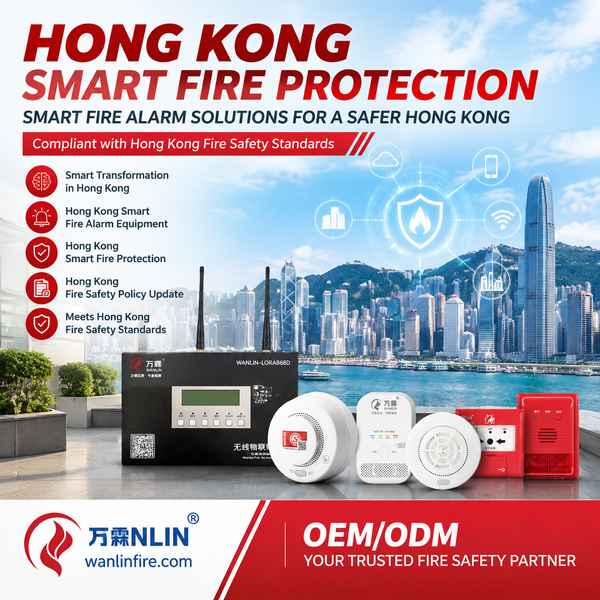
Our scope as a manufacturer covers the device layers and the platform layer: multi-sensor detectors, gateways with dual SIM, manual call points, alarm sounders, and the platform that receives, processes, timestamps and forwards events. What we cannot be, and do not claim to be, is the registered contractor, the licensed transmission provider or the service provider of record in Hong Kong. We say so in writing before an order, not after a committee asks who signs the certificate.
| Layer | What sits in it | What it has to do | Who carries it |
|---|---|---|---|
| Sensing | Multi-sensor smoke and carbon monoxide detectors | Detect, classify, report health and battery state | RFSIC installs and maintains |
| Network | Gateway with call point, sounder and dual SIM uplink | Local wireless in, public network out, failover on the uplink | RFSIC installs and maintains |
| Platform | Monitoring platform with API and event history | Receive, process, mirror to the department's server, report monthly | IoT FDS service provider |
| Application | Mobile application for frontline use | System information and authorised control at the scene | Provided to the FSD for frontline use |
The buyer-side consequence is simple: a quotation should name the layers. A detector-and-gateway price is a different product from a platform price, and a platform that cannot hand signals onward to the transmission system is not a complete system at all. That is also why the cheapest quotation in this market is often the least complete - the missing layers do not disappear, they reappear as a change order when somebody asks for the certificate.
For the Caine Road block the whole stack comes down to 20 detectors, 2 gateways, 10 extinguishers and one platform subscription zoned by floor. Small by any standard, which is the point: a small system that can be installed in days beats a large one that needs two years and a structural engineer.
Two Sensing Elements, Two Alarm Levels
The single most important engineering decision in this system is that one device holds two sensing elements. Smoke alone cannot tell a smouldering mattress from a wok left on a burner. Carbon monoxide alone is slow on a fast flaming fire. Read together, with two alarm levels, they separate the cases well enough to be useful in a building where four households share one landing.
A smouldering fire gives rising carbon monoxide with little smoke. Cooking aerosol gives smoke without the matching carbon monoxide rise. That difference is what makes a pre-alarm level worth having: the system warns, the building responds, and the fire service is not called for dinner. On Caine Road, where 3 households per floor share a landing, that logic is doing real work every evening.
Our WANLIN-770 Wireless Pressure Gauge (LoRa / 4G / 433) implements the two-level logic with independent thresholds for the photoelectric chamber and the electrochemical carbon monoxide cell, and writes which element drove the decision into the event log. Configuration for this block: 4G Cat-1 pressure configuration — 4G Cat-1 uplink for remote pump houses, tank farms and stand-alone risers reporting pressure direct to the cloud. Health, battery state and drift travel on the same channel, so a drifting chamber becomes a maintenance item rather than a surprise at the annual inspection.
| Condition | Smoke channel | Carbon monoxide channel | System action |
|---|---|---|---|
| Cooking aerosol | Rising | Flat | Pre-alarm level, local warning, logged |
| Smouldering fire | Low or slow | Rising | Pre-alarm, then fire level as carbon monoxide climbs |
| Flaming fire | Fast rise | Rising | Fire level, sounders, transmission onward |
| Incense or steam | Short spikes | Flat | Absorbed, no call, logged for review |
Siting beats tuning. The in-unit detector belongs near the entrance, between the sleeping space and the escape route, not in the kitchen. A chamber mounted over a cooking hob will argue with the residents every night, and no algorithm fixes a bad position. That is a commissioning instruction, not a preference, and it is the first thing we check on a survey.
There is a commercial reason to care as well as a technical one. A programme that generates call-outs loses the committee, and the committee is the customer. Two sensing elements plus correct siting is what keeps the platform quiet enough that residents still trust the alarm on the night it does sound.
Configuration for a 5-Storey Block on Caine Road
Quantity is derived from the building, not from a package. Common areas need at least one detector per floor, with the exact number and position decided by floor area and layout. Each domestic unit takes one detector in the living room near the main entrance. Non-domestic units are decided on actual conditions. Everything else - gateway count, sounder placement, extinguisher brackets - falls out of the survey.
For the Caine Road block the survey produced the schedule below: 5 floors, 3 units per floor, 15 units in total, 20 detectors counting both in-unit and landing devices, 2 gateways, and 10 extinguishers at two 5 kg dry powder units per floor.
| Item | Quantity | Basis |
|---|---|---|
| Multi-sensor smoke and carbon monoxide detector, in-unit | 15 | One per unit, near the entrance |
| Multi-sensor smoke and carbon monoxide detector, common area | 5 | At least one per floor, adjusted for layout |
| Gateway with call point, sounder and dual SIM uplink | 2 | Coverage survey on the stair core |
| Portable fire extinguisher, 5 kg dry powder | 10 | At least two per floor |
| Platform subscription with API, event history and mobile app | 1 building | One site, zoned by floor |
| Spare detectors held by the contractor | 3 | So a fault does not wait on a shipment |
Two details save the most time later. First, every device ships with an identification number and a label, and the platform names devices by floor and position - a fault that reads "third floor landing" is a five-minute visit, while a fault that reads "device 47" is an argument. Second, the platform is zoned by floor from day one, so a commercial podium or a workshop level reports separately from the residential floors above it instead of being untangled after handover.
We also push a sample kit before a full order: a small kit by air inside ten to fifteen days, enough for a partner to survey one floor, mount a handful of devices and watch the event stream for a month. Every buyer who has skipped that step has paid for it later in call-backs.
Gateways on the Landing: Local Wireless In, Dual SIM Out
The gateway is the hinge of the whole system. Detectors reach it over a localised wireless link - in our implementation a sub-GHz physical layer at low duty cycle, which is what buys 4 years of battery life on a sealed cell - and it reaches the platform over a public 4G or 5G network. The department asks for two SIM cards from different operators, and there is a reason for that specificity: a single operator's outage in a stair core is not a rare event, it is a Tuesday.
On a 5-storey block on Caine Road we would place 2 gateways, each at a stair landing with a clear path to the floors it serves, each on two SIMs from different operators, each with a backup battery behind the mains feed. Where the survey shows a weak path - a rooftop tank, a metal security gate, a mezzanine plate - the answer is a second gateway or a short external antenna run, not a higher transmit power claim on a datasheet.
Acceptance day started with a clock check. Every event class was fired in sequence - pre-alarm, fire, fault, status - and each platform timestamp was compared with the time on the tester's own handset.
Field note - event stream checked against the platform clock, Caine Road: "If the platform clock and the device clock disagree, every report you ever file is wrong," the integrator said. "We synchronise first and test second."
All four event classes logged with matching timestamps, offsets recorded in the commissioning file, and the monthly report template set to show measured values rather than averages.
Ten Seconds, Twenty Seconds, One Hundred Seconds
Timing is where a specification stops being prose. The department published how long each signal class may take to appear on the platform, split by power source because a battery device polls differently from a mains device. Any supplier quoting this work should be able to fill the table from their own platform logs rather than from a brochure.
| Signal | Mains-powered equipment | Battery-powered equipment |
|---|---|---|
| FIRE | 10 seconds or less | 20 seconds or less |
| PRE-ALARM | 10 seconds or less | 20 seconds or less |
| FAULT | 20 seconds or less | 20 seconds or less |
| STATUS | 100 seconds or less | 100 seconds or less |
Separately from the signal classes, the heartbeat keeps the building honest about presence. Mains-powered transmission equipment checks in at 30 minutes or less; battery-powered equipment at 24 hours or less. A device that misses its heartbeat is a device the platform can name, floor and number - which is what turns a battery claim into a service level.
| Equipment | Heartbeat interval | What a miss means |
|---|---|---|
| Mains powered | 30 minutes or less | Fault raised, contractor notified |
| Battery powered | 24 hours or less | Fault raised, device identified by floor and number |
| Gateway uplink | Continuous with dual SIM failover | Automatic switch to the second operator |
The second table is the one that gets skipped during commissioning and then becomes the entire maintenance story. A battery device that stops reporting is not a nuisance, it is an unprotected room, and the platform has to be able to name it. We surface missed heartbeats, low battery, drift and tamper as separate fault classes so a contractor can triage rather than guess.
One clause worth writing into any specification: these are measured end to end, from the sensing element to the platform, not from the gateway outwards. A supplier who quotes only the uplink leg is answering a different question.
On the Caine Road installation the platform timestamps each class separately, so the monthly report can show measured values against the limits rather than a single average that hides the worst case.
From a Chamber on Caine Road to a Crew on the Street
An event in this system has more hops than most buyers expect, and each hop is somebody's contractual responsibility. Understanding the chain before you buy tells you what you are actually selling - and what you are not.
| Hop | What happens | Who owns it |
|---|---|---|
| 1. Detection | Smoke and carbon monoxide evaluated, alarm level set | Detector, RFSIC maintained |
| 2. Local link | Sub-GHz wireless hop to the landing gateway | Gateway, RFSIC maintained |
| 3. External link | 4G or 5G with dual SIM failover | Mobile operators, contracted by the service provider |
| 4. Platform | Processing, status monitoring, event log | IoT FDS service provider |
| 5. API mirror | All signals sent to the department's server | IoT FDS service provider |
| 6. Transmission | Fire alarm signal to the Fire Services Communications Centre | Transmission service provider |
| 7. At the scene | Firefighters read and control via the mobile application | Service provider, department users |
What a factory can do is build the devices and a platform that exposes a clean, timestamped, correctly formatted interface. What a factory cannot do is be the licensed transmission path into the department, and should not claim to be. Our job is to make sure the handover at hops four and five is clean enough that the Hong Kong registered parties meet their own obligations without building a translation layer.
Which raises the question buyers should ask first: can the platform export? A report locked inside a vendor dashboard is a report the committee cannot file, cannot show an insurer and cannot hand to a successor contractor. Ours exports the event history, the fault log with durations, and the device inventory with battery and health states, in a form that survives a change of contractor.
The Radio Question: Bands, Duty Cycle and Who Decides
Radio is the part of this system that varies most by market, and Hong Kong is no exception. Devices in this class generally use a sub-GHz or 2.4 GHz local link between detector and gateway, and a public mobile network between gateway and platform. Which frequencies may be used, at what power, and under what licence or licence-exempt arrangement, is a matter for the project's own telecommunications adviser in Hong Kong, not for an equipment supplier to assert on a quotation.
| Link | Typical arrangement | What the buyer has to settle |
|---|---|---|
| Detector to gateway | Sub-GHz or 2.4 GHz short-range link at low duty cycle | Band, duty cycle and channel plan for this market |
| Gateway to platform | Public 4G or 5G with two SIMs from different operators | Which operators, whose contract, what happens on an outage |
| Alternative uplink | Narrowband IoT or a private LoRaWAN network where a project runs its own | Whether the project or the supplier owns the network |
| Fallback | Second gateway on the stair core, or an external antenna on a short run | Coverage survey readings, not datasheet range claims |
Our position is deliberately narrow and it protects the partner: we publish the band, the duty cycle and the output power of every radio we ship, and we leave the licence determination to the project's adviser. The Office of the Communications Authority publishes the current arrangements, and the department's own guidance sits alongside it.
Two practical points come out of the field. First, congestion is a design input: a stair core with lift machinery, shop shutters and a dozen other systems in the same band will behave differently from an open landing, which is why we scan before we quote. Second, duty cycle is what buys battery life, so a device that reports more often than it needs to is a device that gets replaced a year early.
Which Buildings This Fits, and How the Configuration Changes
Estate block buildings dominate the target stock in Central and Western, and each type pushes the system in a different direction. The type decides detector siting, gateway count and how much of the work is access rather than electronics.
| Building type | The constraint on Caine Road | What the configuration does about it |
|---|---|---|
| Pre-war walk-up | No riser, no roof space, single unlit staircase | monthly performance reports, a component availability figure and an event log the committee can attach to its own minutes |
| Subdivided flat block | Shared meters, cooking on every floor, no single owner able to sign | Detectors inside each unit plus one per landing, two-level logic separating cooking aerosol |
| Village house | Tank and gate shadows, absentee landlord | Gateway clear of the tank shadow, external antenna if the survey needs it |
| Three-nil building | No corporation, no manager, no budget | Two-week installation, one contractor, no water works and no structural consent |
| Older industrial building | Mezzanines, dust, intermittent occupancy | Detectors under each mezzanine as well as at the landing, tamper and fault reporting kept clean |
| Composite with podium | Two ownerships, two fire loads, one staircase | One system zoned so podium and tower report separately |
| Estate block | Committee wants a record, not hardware | Monthly report, availability figure, exportable event log |
| Walled village and temple | Incense, timber, no chasing of walls | Surface-mounted devices sited away from the burner plume, pre-alarm absorbing incense |
Eligibility is separate from configuration, and it is four conditions that all have to hold at once. In practice the fourth one - owners' consent - is what stops projects, and it stops them before any hardware is discussed.
| Condition | What it means on Caine Road | How it is evidenced |
|---|---|---|
| Regulated under Cap. 572 | Composite or domestic building, on or before 1 March 1987 | Building record and the direction itself |
| A fire safety direction has been issued | The department has already served the direction | Copy of the direction held by the owners |
| Six storeys or below | This block is 5 storeys | Approved plans and a site count |
| All owners agree | Detectors in common parts and inside every #rega:433#, transmission and alarm equipment in common parts, extinguishers per floor | Signed consent from every owner, collected door to door |
Applications run on the department's own intention form, returned to the Building Improvement Support Centre on 2272 9112 or at fsdbisc@hkfsd.gov.hk, and the department has said it will publish a list of service providers interested in providing these services. Owners should expect to choose from that list rather than from a search engine, and should treat the department as the authority rather than a supplier's summary.
What the System Costs to Build, Line by Line
Committees vote on one number; buyers need the breakdown. A single headline figure hides the two things that actually change between projects - how much of the spend is hardware and how much is access, commissioning and documents. On the Caine Road block, at the HK$180,000 the survey produced, the split looks like this.
| Line | Share | Amount | What moves it |
|---|---|---|---|
| Devices | About 46 per cent | HK$82,800 | Detector count, gateway count, spares held |
| Platform | About 17 per cent | HK$30,600 | Sites, users, API and reporting requirements |
| Installation and commissioning | About 27 per cent | HK$48,600 | Access, floors, out-of-hours work, antenna runs |
| Documentation and testing | About 10 per cent | HK$18,000 | Declarations, commissioning records, survey report |
| Total, this block | 100 per cent | HK$180,000 | About 13 working days |
Two comparisons put that number in context. Against the traditional route on the same block - about HK$650,000 and twelve to twenty-four months - the difference is roughly HK$470,000 and most of two years of programme. Against the subsidy, the third-round Fire Safety Improvement Works Subsidy Scheme covers this alternative at up to 60 per cent of eligible works and consultancy fees, or the cap for that class of building, whichever is lower: about HK$108,000 here, leaving roughly HK$72,000 for the owners, before any cap is applied.
The line overseas buyers underprice is installation and commissioning, because it is mostly access. 15 units across 5 floors, some tenanted, some locked, some owned by people who have not been to the building in years. We plan one floor per day and we do not start drilling before the consent sheet is complete.
And the line that gets argued about is the platform, because it recurs. Our view is that a recurring platform fee is worth paying only if it buys exportable data: if the event history, the fault log and the device inventory come out in a usable form, the committee and the successor contractor are never locked to a vendor. If they do not, the fee is rent.
Five Ways This Kind of Job Goes Wrong
Every failure below has the same shape: somebody assumed a line instead of measuring it, and the assumption surfaced after the drilling started. None of them are exotic, and all of them are cheaper to prevent at survey stage than to fix at commissioning.
| Failure mode | Where it comes from | What prevents it |
|---|---|---|
| Coverage assumed from a floor plan | A gateway count taken off a drawing rather than off a reading | A survey with readings at every candidate position, signed before the quote |
| Consent that is nearly complete | Tenanted units and absentee owners discovered during installation | Door-to-door consent closed before any plate is fixed; one floor per day afterwards |
| No lawful mains supply for the gateway | The only common-area circuit is switched, or has no spare way | A power note on the survey document, and a written answer before day one |
| A model substituted mid-project | A near-equivalent offered when stock runs short | Device schedule locking model and label, cartons packed to that schedule |
| A platform that cannot export | Discovered when the committee asks for the record | Export written into the contract: event history, fault log, inventory |
On site, a freight forwarder handling the crossing: "The driving time from Shenzhen to Kwai Tsing is a few hours," she said. "The paperwork is what decides the date, every single time."
The fifth one deserves a note because it is the only failure that does not show up in the first year. A system can commission cleanly, run quietly and still be a commercial trap if the building cannot take its own record elsewhere. We write the export into the order rather than into the brochure, and we generate the device schedule from the platform after commissioning so the numbers in the file are the numbers in the system.
On the Caine Road block, the two that would have bitten us were access and power: two of the 15 units were let to tenants who were not on the owners' list, and the only lighting circuit in the common area is switched at the meter rather than at the fitting. Both were caught on the survey morning, which is the only reason the programme is still 13 working days.
Nine Questions an Overseas Buyer Should Ask a Chinese Fire Factory
Sourcing detection equipment from China is not a leap of faith, it is an audit. The buyers who do this well ask the same nine questions in the same order, and they ask them before the first container rather than after the first failure.
| Question | Why it matters | What a real answer looks like |
|---|---|---|
| Which standards does the device hold, and who issued the report? | A declaration without a test report is paper | Named standard, named laboratory, report number, model on the report matching the model quoted |
| What is the battery, and how is the claim measured? | Nominal years mean nothing in a humid stair core | Cell part number, duty cycle, and a platform that reports measured state |
| Can the platform export its own data? | Lock-in is a commercial risk, not a technical one | Event history, fault log with durations, inventory with health states, in an open format |
| What is the radio, exactly? | Spectrum is regulated market by market | Band, power, duty cycle, and a written note that the licence decision is the buyer's adviser's |
| How are devices traced? | A recall without serial numbers is a guess | Serial numbers tied to batch test records and to the packing list |
| What is the second source plan? | Single-source components stop lines | Alternative approved for critical parts, lead time stated |
| What does the sample kit contain, and how fast does it fly? | One floor of data beats ten emails | Kit by air in ten to fifteen days, platform access included |
| How is the shipment packed? | Commissioning runs off the device schedule | Cartons packed to the schedule, labels matching the platform inventory |
| What happens three years from now? | Replacement parts decide whether the log stays clean | Spare holding, same model, same label, stated warranty term |
We publish answers to all nine in writing because it shortens the process for both sides. The two that buyers tell us matter most are the second and the third: a battery claim the platform can prove, and data the buyer can take elsewhere.
One caution worth repeating. No equipment supplier can carry the statutory installation, transmission or certification duties in Hong Kong. A factory that offers to "handle everything" is either working through registered local parties - in which case name them - or is telling a buyer what they want to hear. Ask which it is.
Imported Brand or Source Factory: Where Each Wins
There is a serious case for the incumbent European and Japanese lines, and a buyer who ignores it is not being served. They bring long certification histories, deep installed bases and local engineering support. There is also a serious case for a Chinese source factory, and it is not only price.
| Dimension | Incumbent international brands | Chinese source factory |
|---|---|---|
| Unit price | Highest, with channel margins stacked on top | Factory-direct, typically a fraction of the branded figure |
| Certification history | Longest, widest, best documented | EN 14604 and EN 50291 declarations with CE, RoHS, REACH, FCC and UKCA files; verify per model |
| Lead time and change | Catalogue product, slow to change | Private label, custom housing, custom labelling, faster to adapt |
| Retrofit fit | Designed for new-build wired systems | Battery and wireless designs built for occupied old buildings |
| Platform lock-in | Often closed, proprietary | Open API and exportable event history should be a purchase condition |
| Spare parts and continuity | Strong local stock | Depends on the factory holding spares against the project; ask |
| Best fit | Large new-build projects with wired infrastructure | Old building retrofit, occupied sites, private label programmes |
Our own answer is unromantic. On a 5-storey walk-up on Caine Road with no riser, no roof space and residents who will not move out, a wired catalogue system designed for a new office tower is the wrong tool at any price. On a large new-build with a wired infrastructure budget and a consultant specifying by brand, our equipment is not the obvious first choice, and we would rather say so than lose a partner's second order.
Where we think the comparison is genuinely close, and where buyers should press hardest, is documentation and data. Ask any supplier - imported or Chinese - for the test report behind the declaration, the export format of the event log, and the serial traceability of a batch. The answers separate suppliers far more reliably than the logo does.
The File Behind the Hardware
A Hong Kong handover is a paper event as much as an electrical one. The circular sets the statutory responsibilities, but what closes a job in practice is a file the registered contractor can sign against and the committee can keep. Overseas buyers entering this market consistently underestimate how much of the schedule is document preparation rather than installation.
| Document | What it covers | Who needs it |
|---|---|---|
| Declaration and test report, smoke element | EN 14604 performance | Registered contractor, committee file |
| Declaration and test report, carbon monoxide element | EN 50291 response behaviour | Registered contractor, committee file |
| EN 54 series references where a component is supplied into a system context | System component performance | Consultant and contractor |
| Conformity files | CE and UKCA marking, RoHS, REACH, FCC as applicable | Importer and the buyer's own market |
| Battery transport documentation | Cell type, transport classification, packing | Freight forwarder, airline or carrier |
| Device schedule with identification numbers | Which device is on which floor and in which unit | Contractor, committee, subsidy claim |
| Bilingual labels and operation instruction | Traditional Chinese and English | Committee, residents, inspection |
| Installation and commissioning record | Readings, positions, test results | Certificate file and subsidy claim |
| User manual, warranty and spare parts list | Operation, term, replaceable items | Committee and maintenance contractor |
Two things we do deliberately. First, the device schedule is generated from the platform after commissioning rather than typed by hand, so the numbers in the file are the numbers in the system. Second, we hold the spare parts list against the building for the life of the contract - a replacement detector three years later should be the same model with the same label, not a near-equivalent that changes the commissioning record.
For private label partners the pack is rebuilt under their own brand: artwork, manuals, quick start guides and carton printing, with the underlying test reports traceable to the same production line. That traceability is what lets a partner answer an audit without opening a negotiation with their own supplier.
The Survey Before the Quotation
Nobody should price a Mid-Levels block from a floor plan. The survey produces eight things, and each of them changes either the quantity or the risk.
| Survey item | What is measured | What it decides |
|---|---|---|
| Signal strength and coverage | Path from every unit and landing to each candidate gateway position | Gateway count and antenna work |
| Channel plan | Occupancy and noise floor around the stair core | Which channels the system is configured on |
| Transmission design | Operator coverage at the stair core, dual SIM plan | SIM operators and failover behaviour |
| Physical constraints and power | Mains availability in common areas, mounting surfaces, soffit condition | Mains routes and fixing method |
| Unit access | Occupancy, tenancy, locked units, absentee owners | Installation schedule, one floor per day |
| Fire load and false alarm sources | Kitchens on landings, incense, workshop dust, corridor windows | Detector siting and pre-alarm thresholds |
| Extinguisher positions | Bracket height, approach route, visibility | 10 units, two per floor, 5 kg dry powder |
| Evacuation route | Staircase width, storage on the landing, door swing | Sounder placement and audibility |
On Caine Road the survey took one morning with two people and a handheld receiver. The finding that mattered was not radio: it was that two of the 15 units were let to tenants who were not on the owners' list, which moved the installation start by a week while consent was collected.
The survey also settles the question that comes up on every quotation: whether the gateway can be powered legally. A detector is a battery device and needs nothing from the building. A gateway needs mains, and in older blocks the only supply in the common area is often a lighting circuit that is switched off at night or has no spare way. Finding that out on day one costs a morning; finding it out on installation day costs a week.
We issue the survey as a document, not as a conversation: candidate gateway positions with readings, a marked-up floor plan, the device schedule, the power note and the access constraints. That document is what the contractor prices from and what the committee files.
Coverage Is a Measurement, Not a Claim
Estate block buildings punish radio. A reinforced concrete floor slab takes a real bite out of a sub-GHz link, a metal security gate at the entrance takes another, and a rooftop water tank throws a shadow exactly where a gateway would otherwise go. On the Caine Road block the worst reading we logged was -108 dBm, taken from the top-floor landing to a ground-floor gateway position - workable, but with no margin left for a humid summer and a corridor full of stored goods.
The answer is redundancy rather than power. A second gateway on the stair core means one unit can fail without the building going dark, and a short external antenna run costs less than call-backs. Our WANLIN-770 family supports dual-gateway registration, so a detector that loses its primary path is re-homed automatically and the event is logged as a fault rather than silently absorbed.
Environment matters as much as structure. This block runs at about 24 degrees on the landing in summer with relative humidity around 66 per cent. Condensation and steam are false alarm sources, not detector failures, and they are handled by siting and by the two-level logic rather than by desensitising the chamber.
There is a third factor specific to Hong Kong that visiting engineers miss: the buildings change. A partition goes up, a mezzanine gets inserted, a shop unit changes hands and fills with stock, and the radio path that was fine at commissioning is no longer fine a year later. That is why the coverage survey is a document with readings rather than a verbal clearance, and why we recommend repeating it whenever a block changes use.
Reading the Monthly Performance Report
The service provider produces a monthly performance report for a fitted building, and it is the only document that tells a committee whether the system is still a system three years later. Buyers should ask to see a sample report before ordering, because the difference between a real one and a marketing one is visible in ten seconds.
| Line | What a healthy month shows | What a bad month looks like |
|---|---|---|
| System online rate | 100 per cent, or a named exception with a duration | A percentage with no denominator and no exception list |
| Component availability | Above 99.95 per cent, measured against the device inventory | A rounded figure with no device count behind it |
| Fault count and duration | Each fault named, opened and closed with dates | Faults summarised as a total with no closure dates |
| False alarm count | Zero, or each one attributed to a cause and a siting change | A number with no attribution, or no line at all |
| Missed heartbeats | None outstanding at month end | Devices listed as offline for longer than the repair clock |
| Battery and health states | Declared state per device, with replacements logged | A single average, which hides the worst device on the worst landing |
On reporting, an estate manager with several blocks in the programme: "We roll out block by block," he said. "A configuration we cannot repeat on the next building is a pilot project, not a programme."
The line that gets argued about is the last one. Averaging battery state across 20 devices tells a committee nothing about the one device that matters, which is the one about to fail on the top floor in the wet season. We report per device and let the contractor sort the list, because the 30-day repair clock runs per device, not per average.
One more practical point for overseas partners: the report is also the marketing asset. A distributor who can hand a prospective client twelve months of clean monthly reports from an occupied block is selling evidence, and in this market evidence closes faster than a price list.
Holding False Alarms at Zero While the Building Keeps Living In It
Zero false alarms over a three-month pilot quarter is the result that made this policy possible, and it is worth being clear about how it was achieved: not by making detectors less sensitive, but by giving the system two sensing elements, two alarm levels and a siting plan that respects how people actually cook, burn incense and store things on a landing.
In a Central and Western walk-up the false alarm candidates are predictable. Cooking aerosol in a unit with the door open. Incense at a shrine on the landing. Steam from an open corridor window during the wet season. Workshop dust in an industrial unit. Each has a signature: smoke without a carbon monoxide rise, or a short spike that decays. The system absorbs them at the pre-alarm level and logs them, so the pattern can be reviewed instead of argued about.
The operational discipline matters as much as the electronics. Silent test mode lets a contractor prove the system without emptying the building; day and night modes let a hotel or a school keep a sane acoustic environment; and the drill record belongs in the committee's minutes, not only in the platform.
Seasonality is the part overseas buyers never ask about and Hong Kong contractors always do. Typhoon season brings open windows, wet corridors and condensation on cold surfaces; the wet months push landing humidity to 66 per cent and above. None of that causes a fire, but all of it causes complaints if the siting ignores it, and complaints are what get a system switched off - which is the only outcome worse than a false alarm.
One more honest note. No detection system removes the need for housekeeping. Storage on a landing blocks an evacuation route and it also blocks a sounder; a corridor window left open onto a light well brings steam into the detection zone. The system can absorb the aerosol, but the committee still owns the landing.
Batteries, Heartbeats and the Thirty-Day Clock
Power design in this system is deliberately boring. Detectors run on battery with a service life of three years or more - 4 years on the cells specified for this configuration - and report their own state on the heartbeat. Gateways run on the building's mains supply with a backup battery behind them, because the gateway is the one component that cannot go quiet.
The rule that concentrates minds is the 30-day one: the registered contractor has to complete a repair within 30 days or report the matter to the department. That makes fault reporting a commercial issue rather than a technical curiosity. A platform that surfaces a low battery, a removed detector or an offline gateway on the day it happens is the difference between a routine visit and a reported breach.
| Element | Power | Reporting | Failure behaviour |
|---|---|---|---|
| Multi-sensor detector | Battery, 4 year service life | Heartbeat at 24 hours or less, battery state and drift | Fault raised, device identified by floor and number |
| Gateway | Building mains plus backup battery | Heartbeat at 30 minutes or less, mains-loss fault | Dual SIM failover, backup battery carries the uplink |
| Alarm sounder | Fed from the gateway arrangement | Status and fault on the same channel | Fault raised within 20 seconds |
| Extinguishers | Not applicable | Visual inspection at each visit | Replacement at the next scheduled visit |
The practical failure mode is not a dead cell, it is an undocumented one. A detector that quietly drops out of the network and is not noticed until the annual inspection has left a floor unprotected for months, and under the reporting regime that is a reportable fault rather than a maintenance note. Hence the insistence on heartbeat reporting that names the device, and on a contractor who actually watches the platform rather than logging in once a quarter.
We also specify the cells rather than quoting a number. A three-year life on paper means nothing if the device sits in a humid stair core with a corridor window open; the honest answer is a declared cell, a declared duty cycle, and a platform that reports the measured state so the claim can be checked against the building.
Spare Parts, Warranty and the Three-Year Question
The question that separates a supplier from a vendor is asked about three years after handover: when a detector fails on the fourth-floor landing, what arrives, how fast, and does it change the commissioning record? On the Caine Road block the honest answer has to be written down before the first carton ships, because 20 devices on one platform inventory is a small population and a single substituted model contaminates the file.
| Item | Held where | Typical arrangement | What to write into the contract |
|---|---|---|---|
| Multi-sensor detector | With the maintenance contractor on site | 3 units held against this building | Same model, same label, replacement logged to the same serial list |
| Gateway | With the contractor or the service provider | One spare per programme, not per building | Configuration restored from the site record, not re-engineered |
| Battery cells where replaceable | With the contractor | Declared cell part number, not a generic equivalent | Cell type named so the duty cycle claim still holds |
| Mounting plates and fixings | With the contractor | Consumables held as a kit | Replacement does not change the mounting position |
| Extinguishers | On the bracket, per floor | 10 units, inspected at each visit | Replacement at the next scheduled visit, recorded |
| Platform access and export | With the building | Event history and inventory retained for the contract term | Retention period, and a full export on termination |
Warranty terms in this category are ordinary and worth stating plainly rather than dressing up: a stated term against manufacturing defect, a stated response for a fault report, and a stated commitment that the model supplied at commissioning is the model supplied at replacement. Anything more creative than that is usually a way of avoiding one of the three.
For a private label partner the same logic applies under their own brand, which is why we hold the production record rather than only the shipment record. A partner answering an audit three years later needs the batch, the test log and the component list for the devices already on the wall - not for the devices currently on the line.
Acceptance Testing: What FAT and SAT Actually Check
Two test gates decide whether a Mid-Levels system is signed off or argued about. Factory acceptance happens before anything ships; site acceptance happens after it is installed. Both produce records, and both are cheap compared with discovering the problem later.
| Gate | Check | What passes |
|---|---|---|
| Factory | Chamber response on both sensing elements | Response inside the declared band on every unit in the batch |
| Factory | Battery voltage under load | Cell batch within specification, voltage logged by serial number |
| Factory | Wireless join and rejoin | Device joins, loses, and re-homes without manual intervention |
| Factory | Tamper and burn-in run | Tamper raises a fault; burn-in completes without early failure |
| Site | Coverage readings at every device | Every device meets the margin recorded in the survey |
| Site | Event class timing | FIRE, PRE-ALARM, FAULT and STATUS inside the published limits |
| Site | Uplink failover | Second SIM takes over, event logged, platform notified |
| Site | Fault injection | Removed device and mains loss raise named faults inside 20 seconds |
| Site | Audibility per landing | Measured level with doors shut and windows as the building uses them |
| Site | Silent functional test then audible drill | Full function proven quietly, then an evacuation timed door to door |
The step that gets skipped under pressure is fault injection, and it is the one that proves the maintenance model. Removing a device and watching the platform raise a named fault inside twenty seconds tells the contractor whether the 30-day repair clock is workable in this building before it has to be. A system commissioned without that test is a system whose first fault will be its first surprise.
Handover is not the end of the job. The monthly performance report starts the following month, and the first quarter is when siting mistakes surface - a detector too close to a kitchen door, a corridor window onto a light well, a landing that accumulates storage. Our practice is to review the first quarter's event log with the contractor and adjust siting while the team is still on site.
Commissioning Sequence: Day One to Handover
The sequence below is what a 5-storey block on Caine Road actually looks like from the first visit to the drill. It is included because buyers price the wrong thing when they price only the hardware: the schedule is mostly access, testing and documentation.
| Stage | What happens | What it produces |
|---|---|---|
| Survey | Readings at candidate gateway positions, unit count, power check | Survey document and device schedule |
| Consent and access | Owners and tenants sign, floor-by-floor schedule agreed | Signed consent sheet |
| Fixing | Plates and brackets fixed, no devices mounted yet | Photographic record per level |
| Mounting and numbering | Devices mounted, labelled and registered to floor and position | Device inventory in the platform |
| Gateway and uplink | Mains supply, backup battery, both SIMs commissioned | Failover test record |
| Platform configuration | Zones by floor, thresholds, escalation contacts, report cadence | Site configuration record |
| Silent test | Full functional test with no audible output | Test log with timestamps |
| Fault injection | Device removed, mains removed, battery low simulated | Fault class and timing verification |
| Extinguisher round | 10 units bracketed, heights measured, plates fixed | Photographic record per level |
| Audible drill and handover | Evacuation timed, records filed, certificate issued by the RFSIC | Drill record and certificate |
Two administrative details decide whether the last stage is a formality or a delay. The device schedule has to match the platform inventory, because the certificate file and any subsidy claim both read from it. And the drill has to be recorded in the committee's own minutes, because that is the document the next contractor and the next committee will look for.
Who Owns the Log: Data, Retention and Handover
A fitted building generates four records, and the question of who can produce each one is a contract question rather than a technical one. It comes up twice: when a committee changes service provider, and when an insurer or a successor contractor asks for the history of a building they have never seen.
| Record | Who keeps it | What a buyer should require |
|---|---|---|
| Event history, fire and pre-alarm | Platform, mirrored to the department's server | Exportable with timestamps, per device, in an open format |
| Fault log with durations | Platform, surfaced to the contractor | Open and close dates, so the repair clock is provable |
| Device inventory with health and battery state | Platform, generated from commissioning | Matches the device schedule and the packing list |
| Survey, commissioning and drill records | Contractor, committee and subsidy file | Documents rather than emails, filed with the minutes |
On data, a maintenance contractor holding the service contract: "I price the call-backs, not the boxes," he said. "A system that names its own faults is worth more to me than one that cost less and stayed quiet until the annual inspection."
Two clauses do most of the work. The first is a retention period written into the contract, so a committee knows how far back it can ask. The second is a termination clause that obliges the platform to hand over a complete export rather than a summary - without it, a building that changes provider loses its own history, and the new contractor starts blind on a system that has been running for years.
There is a commercial angle for overseas partners here as well. A distributor who can offer an exportable, well-structured record is offering something several incumbent platforms in this category do not, and it is the single cheapest differentiator available in a market where the hardware itself is increasingly comparable.
How an Overseas Partner Buys This as One Package
The reason one-stop supply wins here is organisational, not technical. A six-storey block in Mid-Levels has nobody whose job is to integrate four vendors. The committee wants one contractor, one schedule and one phone number. That is why we sell the devices, the platform and the documentation as a single package, and why the partner programmes are built around who carries what.
The partner runs a building or IoT platform and wants fire detection as another feed rather than another box: an open API, event history it can consume, and a device health stream it can show its own customers. The commercial shape of that relationship: API access, event history export, device health feed, Modbus and MQTT gateways.
Partner note - a platform company adding fire as a data source: "If the fire system cannot talk to our platform it becomes a separate project with a separate contract," the technical director said. "We wanted one log."
| Cooperation model | How it works | What we supply |
|---|---|---|
| Distributor and importer | Hold stock in your own market, sell under our brand or yours, and open a territory discussion once annual volume is committed. | MOQ from a mixed starter order, sample kit by air, marketing files and training material |
| Private label and OEM | Your brand on the detector and the gateway, your artwork on the carton, your language on the quick start guide. | Private label from low volumes, custom housing colour, custom label and packaging artwork |
| Contractor and integrator supply | Hardware and platform supplied to your project, with the statutory installation and maintenance work staying with your own registered team. | Project pricing, commissioning records, API and event history access, spare parts holding |
| Platform and technology partner | Take the devices onto your own platform through the API, or run ours white labelled underneath yours. | API documentation, event schema, device health feed, joint support model |
| Trading company and sourcing office | Mixed containers consolidated at the factory, one document set, inspection before loading. | Mixed SKU consolidation, third-party inspection, FOB, CIF and EXW terms |
| Agent with territory commitment | Represent the line in a defined territory, bring the projects, and hold the commercial relationship with the end client. | Territory discussion, lead protection, joint quotation support, factory visit programme |
Terms are ordinary and stated up front: factory-direct pricing, private label and OEM from low volumes, sample kits by air inside ten to fifteen days so a partner can survey and test one floor before committing, FOB, CIF and EXW terms, mixed containers consolidated at the Shenzhen factory, and a distributor or agent programme with territory discussion for partners who commit to annual volume. Consignments for Hong Kong programmes cross from Shenzhen through Yantian or Shekou into Kwai Tsing, and onward export runs on the same consolidated schedule.
What we ask a new partner for is small: one building, one survey, one floor installed, one month of platform data. That is enough to prove the coverage, the timing and the reporting in the partner's own market, and it is a cheaper argument than any document we could send.
Logistics for Hong Kong work are short and predictable - Shenzhen to Kwai Tsing is a same-day crossing once the paperwork is done - but the paperwork decides the date. Numbered cartons, a packing list that matches the device schedule, and certificates that match the shipment are what keep a container out of a warehouse. We pack to the device schedule for exactly that reason.
Questions Overseas Buyers Ask About Hong Kong IoT Fire Detection
What is an IoT Fire Detection System in plain terms?
It is a fire detection system whose devices report over a wireless link to a gateway, which forwards events to a monitoring platform over a public mobile network, and whose platform then hands fire alarm signals onward to the Fire Services Communications Centre. In Hong Kong the Fire Services Department accepted such a system, together with portable fire extinguishers, as an alternative to the hose reel system and the manual fire alarm system in composite and domestic target buildings of six storeys or below under the Fire Safety (Buildings) Ordinance, Cap. 572, from 30 April 2026.
Which parts count as fire service installations and which do not?
The multi-sensor detectors and the gateways are fire service installations and equipment - they are installed and maintained by a registered fire service installation contractor, which issues the certificate. The monitoring platform and the mobile application used at the scene are not fire service installations; they sit with the service provider. Knowing the split tells a buyer exactly what a factory can supply and what it legally cannot.
Which radio bands do these systems use in Hong Kong?
Devices typically use a sub-GHz or 2.4 GHz local link between detector and gateway, and a public 4G or 5G network between gateway and platform. Which frequencies may be used, and whether a licence is required, is a question for the project's own telecommunications adviser in Hong Kong; the Office of the Communications Authority publishes the current arrangements. We publish the band and duty cycle of every radio we ship so that question can be answered before an order is placed rather than after.
How fast does a signal have to reach the platform?
Fire and pre-alarm signals have to appear on the platform within 10 seconds from mains-powered equipment and within 20 seconds from battery-powered equipment. Fault signals have to arrive within 20 seconds regardless of power source, and status signals within 100 seconds. Heartbeat checks run at 30 minutes or less for mains equipment and 24 hours or less for battery equipment.
Why smoke and carbon monoxide in the same device?
Smoke alone cannot separate a smouldering mattress from a wok left on a burner. Carbon monoxide alone is slow on a fast flaming fire. Read together, with two alarm levels, they separate the two cases: a smouldering fire gives rising carbon monoxide with little smoke, while cooking aerosol gives smoke without the matching carbon monoxide rise. That is what lets a pre-alarm level be useful instead of noisy.
What did the Hong Kong pilot actually record?
Ten target buildings of six storeys or below across ten districts were fitted and assessed from 1 January to 31 March 2026. The department reported no false alarms over that period, a 100 per cent system online rate and better than 99.95 per cent component availability.
What does the alternative cost compared with a hose reel system?
The department's own comparison puts hose reel and manual fire alarm works at roughly HK$600,000 and one to two years, against roughly HK$200,000 and about two weeks for the detection system with extinguishers. A real figure for a particular block comes out of the survey: unit count, detector count, gateway count, whether an unswitched mains supply exists in the common area, and whether antenna work is needed.
What does factory acceptance and site acceptance testing cover?
Factory acceptance covers the batch on the bench: chamber response on both elements, battery voltage under load, wireless join and rejoin, tamper detection and a burn-in run. Site acceptance covers the installed system: coverage readings, event class timing, failover, audibility on each landing, fault injection, extinguisher positions and a silent functional test before any audible drill.
Who is responsible for installation, maintenance and certification?
A registered fire service installation contractor installs, maintains, inspects and repairs the fire service installation components, issues the certificate, and has to complete repairs within 30 days or report the matter to the department. The transmission service provider maintains the communication path into the department. The service provider coordinates the whole programme and produces the site survey, feasibility report and monthly performance report.
What can a Chinese factory actually supply into this?
The device and platform layer: multi-sensor detectors, gateways with dual SIM and manual call points, alarm sounders, the monitoring platform with its API and event history, and the application used at the scene - plus the documentation pack and the spare parts holding. Listing, installation, transmission and certification in Hong Kong belong to the Hong Kong registered parties. A supplier who claims otherwise is selling something it cannot deliver.
Does this apply to a building of more than six storeys?
Not through this route. The alternative set out in the circular applies to composite and domestic target buildings of six storeys or below under the Fire Safety (Buildings) Ordinance. A taller building is not made eligible by buying more detectors, and the requirements it already carries are not reduced by installing one. Buyers should confirm the storey count from approved plans rather than from the number of floors that appear to be occupied, because mezzanines and rooftop structures are exactly where the two numbers disagree.
Who owns the event log, and what happens when the committee changes contractor?
The log should belong to the building, not to the supplier. Practically, that means three things written into the contract before installation: the event history, the fault log with durations and the device inventory are exportable in an open format; the retention period and who can request a copy are stated; and on termination the platform hands over a complete export rather than a summary. A committee that cannot take its own record to a successor contractor has bought a subscription, not a system.
How does a new overseas partner start?
With one building. We ship a sample kit by air inside ten to fifteen days - enough detectors, one or two gateways and platform access to survey one floor, mount a handful of devices and watch the event stream for a month. Then we talk about MOQ, private label artwork, packing to the device schedule and consolidation into mixed containers.
Market Direction: What Central and Western Buyers Are Positioning For in 2026
- Two sensing elements in one device has become an expectation in retrofit work, not a premium option.
- Battery claims are judged on reported state, not nominal years. A device that cannot say it is still there is not a monitored device.
- Bilingual Traditional Chinese and English labelling is requested well beyond Hong Kong, including other Chinese-language markets in the region.
Our read from the enquiries reaching the factory is consistent: the partners who win this work are the ones who can prove a system rather than describe one - coverage readings, event timing, an exportable log, and a declaration pack that matches the model on the carton. That is what we build for.
Further reference for buyers checking the policy and the technical background: Office of the Communications Authority, together with the Fire Services Department circular itself.
Wanlin - Internet of Things fire detection system manufacturer and export supplier, Shenzhen, China, for Hong Kong programmes. Wanlin Manufacturing Group builds multi-sensor smoke and carbon monoxide detectors with two-level pre-alarm and fire logic, dual SIM 4G and 5G gateways carrying manual call points and alarm sounders, and the monitoring platform with API, event history, device health reporting and the frontline application - supplied factory-direct to registered contractors, service providers, platform companies, integrators, distributors and trading companies. OEM, ODM and private label, bilingual Traditional Chinese and English labelling, EN 14604 and EN 50291 documentation with CE, RoHS, REACH, FCC and UKCA files. Statutory installation, transmission and certification responsibilities in Hong Kong rest with the Hong Kong registered parties; we supply the device and platform layer behind them.
- Email: wanlinfirecontrol@163.com
- Export hotline: +8613261677119
- Website: www.wanlinfire.com
- Shenzhen HQ: Wanlin Group, Building B, Building 1, Beisida Medical Device Building, 28 Nantong Avenue, Baolong Community, Baolong Sub-district, Longgang District, Shenzhen, Guangdong, China
- Programme markets: Hong Kong first, with export supply across Asia, the Middle East, Europe, Africa, Latin America and the Pacific - 24-hour response
- Global partner recruitment: distributors and importers, registered fire service installation contractors, transmission service providers, platform and technology partners, building services contractors, system integrators, estate operators, trading companies and sourcing offices welcome - OEM, ODM, private label and territory programmes open for 2026-2027
- Programme reference: FSD Circular Letter No. 3/2026, 30 April 2026; Fire Services Department Building Improvement Support Centre, 2272 9112, fsdbisc@hkfsd.gov.hk
